Lyophilized
- Condition
- Cold, dark, desiccated
- Notes
- Dry powder is the stable form. Refrigerate for near-term; freeze for long-term. Keep sealed and away from ambient moisture.
Research Use Only
LAB RESOURCES
Standards for preparing, storing, and documenting research compounds in the lab.
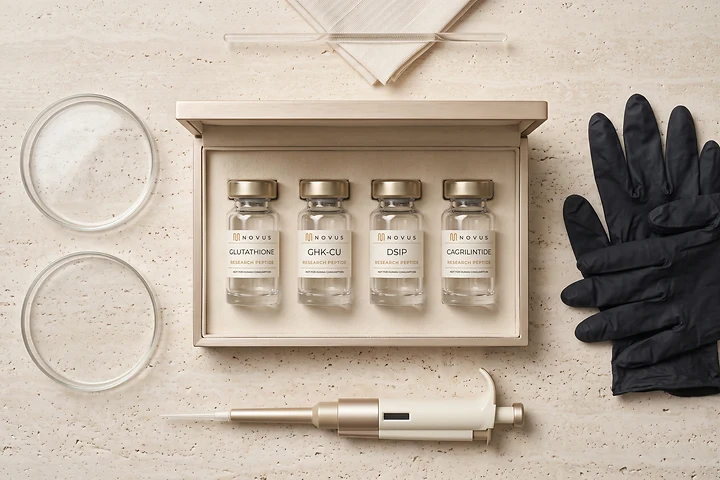
For research use only. Products are sold strictly as research compounds for in-vitro and laboratory investigation. Not for human or veterinary consumption.
This guide covers material handling — how to reconstitute, store, and verify a compound as a laboratory reagent. It covers laboratory handling only and is not guidance for use in people or animals.
Handle all compounds as laboratory reagents of unknown hazard. Wear appropriate PPE, work in a suitable environment, and dispose of materials per your institution's requirements.
Lyophilized peptide ships as a dry cake or film under vacuum. Reconstitution returns it to solution at a known concentration — the goal is a fully dissolved, undegraded stock.
Work from the stock concentration your assay requires. Solvent volume = peptide mass ÷ target stock concentration.
Worked Example
10 mg of peptide dissolved in 2 mL of solvent gives a 5 mg/mL primary stock. The same 10 mg in 1 mL gives 10 mg/mL. From the primary stock, dilute into assay buffer to reach your working concentration — typically in the µg/mL or µM range, as your experimental design requires.
Important
Reconstituted stock is far less stable than dry powder. Reconstitute only what the work in front of you calls for, and keep the rest lyophilized until needed.
Peptides degrade along predictable routes — hydrolysis, oxidation, and aggregation — all accelerated by heat, light, moisture, and repeated temperature swings.
| State | Condition | Notes |
|---|---|---|
| Lyophilized | Cold, dark, desiccated | Dry powder is the stable form. Refrigerate for near-term; freeze for long-term. Keep sealed and away from ambient moisture. |
| Reconstituted | Refrigerated, dark | Substantially shorter usable life than powder — days to a few weeks depending on sequence and solvent. A bacteriostatic solvent extends this; plain water shortens it. |
| Long-term stock | Frozen, single-use aliquots | Where a solution must be held, aliquot first so each portion thaws once. |
Beyond-Use Dating
Assign a beyond-use window per compound and solvent rather than a single blanket figure, and label every vial with its date. Some sequences (copper complexes, certain fragments) are notably more or less robust than average — track them individually.
A Certificate of Analysis is how you verify identity and purity before a compound enters any work. Knowing how to read one separates a documented reagent from an unknown.
HPLC Purity
A percentage from high-performance liquid chromatography — the fraction of material that is the target peptide vs. related impurities. Look at the chromatogram, not just the number: one clean dominant peak is what you want.
Mass Spec (MS)
Confirms identity by molecular weight. The observed mass should match the theoretical mass for the sequence — the check that the vial contains what the label claims.
Net Peptide Content
The most misread figure. Gross vial weight includes salts, counter-ions, and residual water. Net peptide content is the actual peptide fraction — two "10 mg" vials can differ materially in real peptide mass.
Third-Party Testing
The strongest COA is from an independent lab, not the seller. An in-house-only certificate is weaker evidence than the same panel run externally.
A complete certificate names the amino-acid sequence, molecular formula, and CAS or reference identifier where one exists. Cross-check these against the compound you ordered — a mismatch here is a stop sign.
Best Practice
Keep the COA with the lot. When a vial arrives, log its lot number, purity, and net content, and file the certificate against that lot so any future question traces back to documented data.
Good records make a reagent traceable and results reproducible. This is the difference between a research inventory and a drawer of unlabeled vials.
This reference covers laboratory handling of research compounds only. It is not medical or veterinary guidance, and nothing here should be read as such. Products are for research use only and are not for human or animal consumption.
 NOVUS
Mastery in Every Vial · Redefine the Standard
Verification
Confirm the statement above to continue.